
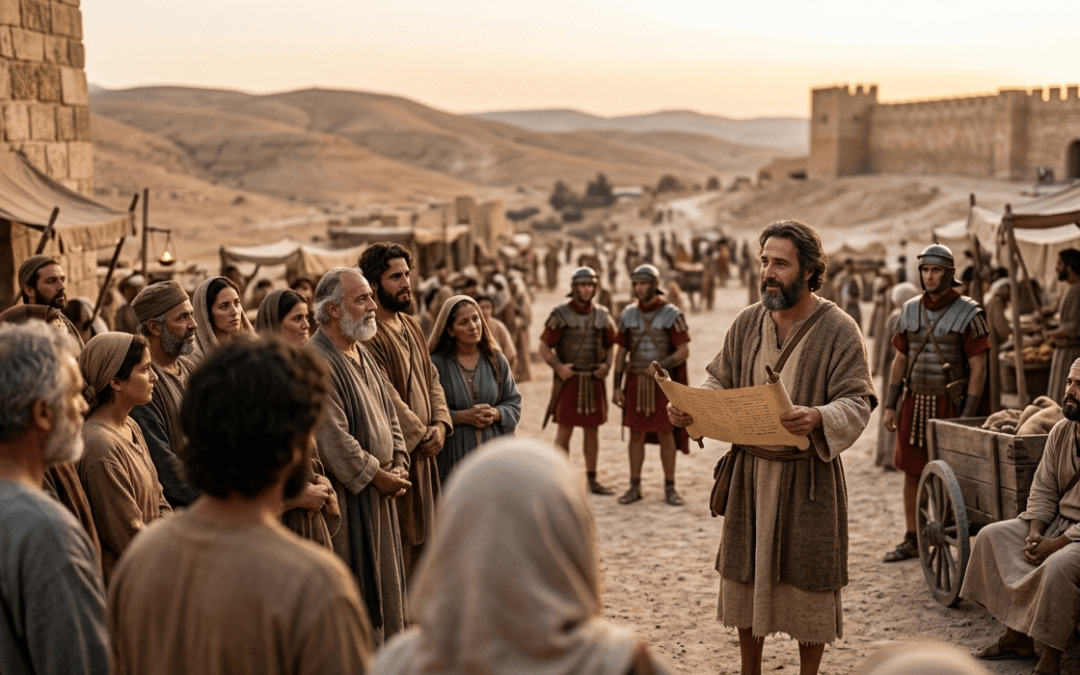
One of the most interesting historical questions about Christianity is this:
If early Christians were a small, persecuted minority, why didn’t their writings disappear like many other movements in history?
Instead, their writings spread across continents, were copied thousands of times, and became some of the best-preserved documents in the ancient world.
That’s historically unusual.
So what happened?
Let’s look at the evidence.
Christianity Spread Without Military Power
Most movements that spread widely in history did so through:
- Military conquest
- Political authority
- Cultural dominance
Christianity had none of these.
Early Christians:
- Had no army
- Held no political office
- Were often persecuted
- Were socially marginalized
Yet within a few centuries, Christianity spread throughout the Roman Empire.
This is not how movements typically expand.
Instead of conquering, Christianity spread through relationships, travel, and communication.
That alone makes its growth historically significant.
The Roman World Was Uniquely Positioned for Spread
Several historical conditions made the spread of Christianity unusually possible.
A Common Language
Much of the Roman world spoke Koine Greek, a common trade language.
This meant:
- Writings could be widely understood
- Letters could circulate between communities
- Teachings could spread rapidly
This is one reason the New Testament was written primarily in Greek rather than Hebrew.
It made the message portable.
Roman Roads and Infrastructure
The Roman Empire built an extensive road network connecting cities across vast distances.
For example, Paul the Apostle traveled extensively through:
- Asia Minor
- Greece
- Rome
These journeys weren’t accidental - they followed established trade and travel routes.
In a sense, the infrastructure of the Roman Empire unintentionally helped Christianity spread.
Early Christians Copied and Shared Writings Rapidly
Another key factor is how early Christians handled their writings.
They didn’t centralize them.
Instead:
- Letters were copied locally
- Gospels were shared between communities
- Teachings were read publicly
For example, letters written to one church were often copied and sent to others.
This created decentralized preservation.
That matters historically.
Because when texts are spread across many locations:
- They are harder to destroy
- Harder to control
- Harder to rewrite
This is one reason we now have thousands of manuscript copies.
The Christian Message Was Socially Compelling
Christianity also offered something unusual for the ancient world.
It emphasized:
- Care for the poor
- Value for the marginalized
- Unity across social classes
Roman society was highly hierarchical:
- Slave vs free
- Rich vs poor
- Male vs female
Christianity introduced a radically different idea - dignity across social boundaries.
For example, Paul the Apostle wrote about unity across divisions.
This made Christianity appealing to:
- Slaves
- Women
- The poor
- Outsiders
In many cases, these groups formed the backbone of early Christian communities.
Persecution Didn’t Stop the Movement - It Strengthened It
Authorities sometimes attempted to stop Christianity through persecution.
This included:
- Arrests
- Executions
- Social pressure
But instead of collapsing, Christianity often grew.
Early Christian writer Tertullian famously observed:
“The blood of the martyrs is seed.”
Historically, persecution often had unintended effects:
- It drew attention
- It strengthened communities
- It inspired others
This resilience made Christianity harder to suppress.
Early Christians Were More Organized Than We Assume
Early Christianity wasn’t just scattered individuals.
It developed:
- Leadership structures
- Communication networks
- Shared teachings
For example, Ignatius of Antioch wrote letters to multiple churches in the early 2nd century.
These letters show:
- Connected communities
- Shared beliefs
- Ongoing communication
This helped preserve teachings and writings across regions.
Christianity Grew Before Political Support
Some assume Christianity spread because of imperial backing.
But that came later.
In 313 AD, Constantine issued the
Edict of Milan, which legalized Christianity.
But by that point:
- Christianity had already spread widely
- Communities existed across the empire
- Writings were already circulating
In fact, historians estimate that Christians may have made up around 10% of the empire before Constantine.
So Christianity didn’t spread because of power.
It gained power after it had already spread.
Independent Communities Preserved the Texts
Christian writings were preserved across different regions:
- Egypt
- Syria
- Asia Minor
- Rome
These communities copied texts independently.
So even if one region lost manuscripts:
Others preserved them.
This is one reason the New Testament is so well documented today.
A Historically Unusual Movement
From a historical perspective, Christianity’s spread is remarkable:
- No military expansion
- No initial political power
- Periodic persecution
- Decentralized communities
Yet:
- Rapid growth
- Wide geographic spread
- Strong manuscript preservation
That combination is uncommon in history.
So Why Did a Persecuted Minority’s Writings Survive?
Because several factors converged:
- Roman infrastructure
- Common language
- Decentralized copying
- Strong communities
- Compelling social message
- Resilience under persecution
Together, these created a movement that was difficult to suppress.
Instead of disappearing, their writings multiplied.
And that’s one of the most historically intriguing aspects of early Christianity -
a persecuted minority whose writings didn’t vanish… but shaped history.