
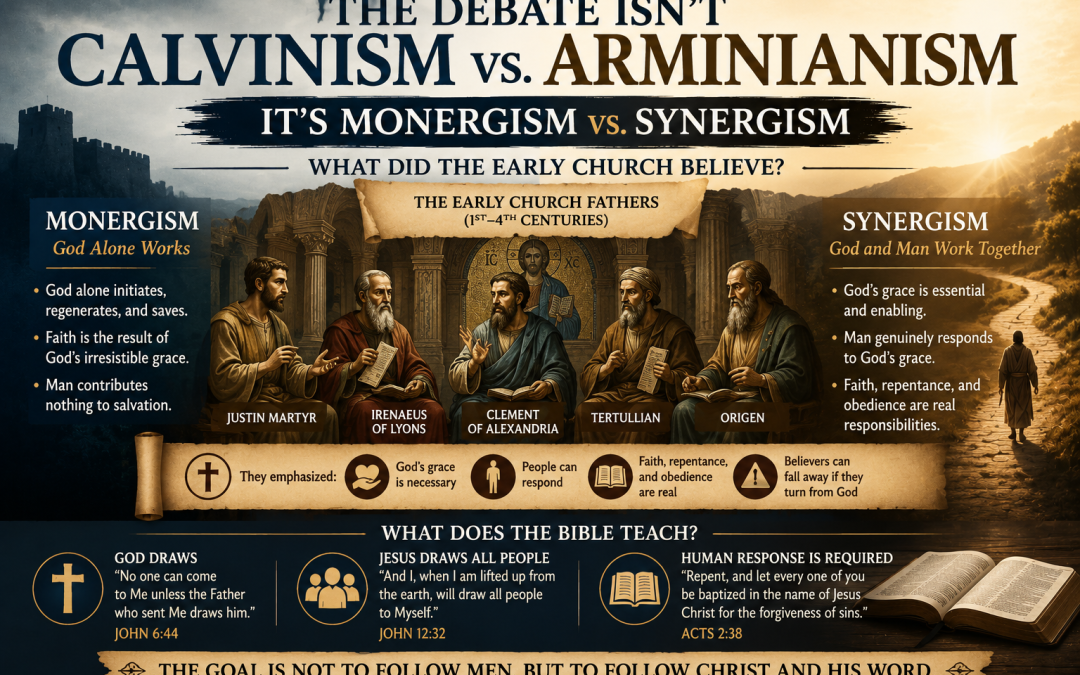
Many theological debates are framed as Calvinism versus Arminianism.
But that framing can be misleading.
After all, both John Calvin and Jacob Arminius lived more than 1,500 years after Christ. Neither was present when the New Testament was written. Neither was present when the earliest generations of Christians interpreted the apostles' teachings.
If we are truly interested in biblical theology, perhaps we should ask a different question.
Not:
"Was the early church Calvinist or Arminian?"
But:
"How did the earliest Christians understand the relationship between God's grace and human response?"
The real historical debate is not Calvinism versus Arminianism.
The deeper question is monergism versus synergism.
What Are Monergism and Synergism?
Monergism comes from two Greek words meaning "one working."
In monergistic theology, God alone acts in bringing a person to salvation. Regeneration precedes faith, and the sinner contributes nothing to the process except the sin from which he is saved.
Synergism comes from Greek words meaning "working together."
Synergism teaches that salvation is entirely dependent upon God's grace, but that God does not eliminate human response. Grace enables, convicts, draws, and empowers, while people remain responsible for how they respond.
The debate is not whether grace is necessary.
Both sides agree that without God's grace no one could be saved.
The debate is whether God's grace can be resisted.
The Earliest Christians
When we read the earliest Christian writers after the apostles, a pattern begins to emerge.
They consistently call people to repent.
They warn believers about falling away.
They emphasize obedience, faithfulness, and perseverance.
Most importantly, they speak as though people genuinely have a responsibility to respond to God.
This language appears repeatedly in the writings of early Christian leaders such as Justin Martyr, Irenaeus, Tertullian, and Clement of Alexandria.
These writers frequently describe humanity as capable of responding to God's call, even while affirming the necessity of divine grace.
Their emphasis sounds much closer to what we would call synergism than later monergism.
Augustine Changed the Conversation
The discussion changed significantly with Augustine of Hippo.
In his conflict with Pelagius, Augustine strongly emphasized humanity's dependence upon God's grace.
This emphasis was important because Pelagius had minimized the effects of sin and elevated human ability.
Augustine was right to insist that salvation begins with God's initiative.
However, some of Augustine's later conclusions regarding predestination, irresistible grace, and election went beyond what many earlier church fathers had explicitly taught.
This is why historians often note a significant shift in the theological conversation after Augustine.
What About the Bible?
The most important question is not what Augustine believed.
The most important question is not what Calvin believed.
The most important question is not what Arminius believed.
The question is what Scripture teaches.
Throughout the New Testament, we find two truths presented side by side.
First, salvation is impossible without God's grace.
Jesus said:
"No one can come to Me unless the Father who sent Me draws him." (John 6:44)
Second, people are repeatedly called to respond.
Jesus also said:
"And I, when I am lifted up from the earth, will draw all people to Myself." (John 12:32)
The apostles continually called people to repent, believe, and receive the gospel.
The biblical writers never treat these commands as meaningless.
They speak as though people are genuinely responsible for their response to God's grace.
The Problem with Labels
The danger of theological labels is that they can become shortcuts.
Someone says "Calvinist."
Someone else says "Arminian."
The conversation ends before the Scriptures are opened.
Yet neither label appears in the Bible.
The apostles never asked people whether they were Calvinists or Arminians.
They preached Christ.
They proclaimed God's grace.
They called people to repent and believe.
A Better Question
Instead of asking whether the early church was Calvinist or Arminian, perhaps we should ask:
How did the earliest Christians understand grace, faith, repentance, and human responsibility?
The historical evidence suggests that the earliest church generally emphasized both God's initiative and humanity's responsibility.
Grace was necessary.
Faith was necessary.
Repentance was necessary.
Response was necessary.
The earliest Christians did not appear troubled by holding these truths together.
Perhaps we should not be either.
The goal is not to follow Calvin.
The goal is not to follow Arminius.
The goal is to follow Christ and allow Scripture to speak for itself.