
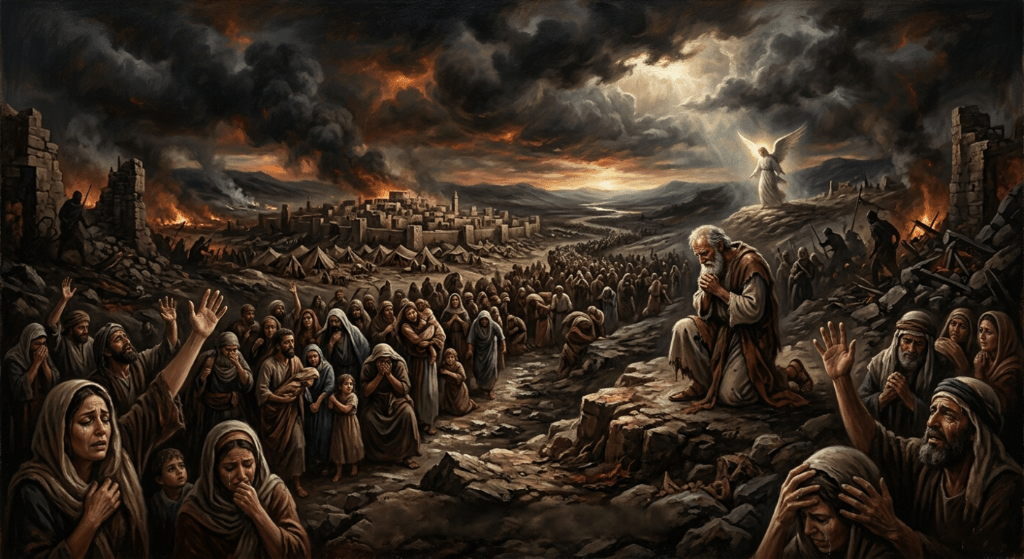
Is It a Future 7-Year Tribulation or a Fulfilled Biblical Pattern?
The phrase “Jacob's Trouble” is often used to support the idea of a future seven‑year tribulation period specifically for Israel, separate from the Church. This interpretation is common in modern dispensational theology and is frequently connected with the rapture, the Antichrist, and the end‑times timeline.
However, when we carefully examine Scripture, context, and history, the case for “Jacob's Trouble” being a future-only event becomes far less certain. In fact, there is strong biblical and historical evidence that this prophecy has already found fulfillment — or at least primary fulfillment — in past events.
Let's examine the biblical text carefully.
The Only Place “Jacob's Trouble” Appears
The phrase appears only once in the entire Bible:
Jeremiah 30:7
"Alas! For that day is great, so that none is like it; and it is the time of Jacob's trouble, but he shall be saved out of it."
This is important. The entire concept of “Jacob's Trouble” as a technical end‑times term is built on a single verse.
Notice what is NOT in this passage:
- No seven‑year timeline
- No Antichrist
- No rapture
- No mention of the Church being removed
- No explicit end‑of‑world language
Instead, we must interpret the phrase within its immediate context.
The Context of Jeremiah 30
Jeremiah 30–31 is often called "The Book of Consolation" because it describes:
- Israel's suffering
- National judgment
- Exile
- Restoration
- New covenant promises
Jeremiah 30:3 says:
"For behold, days are coming… when I will restore the fortunes of my people, Israel and Judah… and I will bring them back to the land."
This strongly suggests Jeremiah is speaking about:
- National suffering
- Followed by restoration
This fits the historical events of:
- Babylonian exile (586 BC)
- National suffering
- Later restoration under Persian rule
This alone provides a strong historical candidate for "Jacob's Trouble."
"Saved Out Of It" - Not Removed Before It
Jeremiah 30:7 says:
"He shall be saved out of it"
This is significant.
The text does NOT say:
- Saved before it
- Removed from it
- Escaped prior to it
Instead, the pattern is:
- Trouble occurs
- God delivers His people through it
This is the consistent biblical pattern:
- Israel in Egypt (Exodus 1–14)
- Daniel in the lions' den (Daniel 6)
- Shadrach, Meshach, and Abednego (Daniel 3)
- Early Church persecution (Acts 8)
God's people are often preserved through tribulation, not removed from it.
"A Time Like None Other" - Not Unique to One Event
Jeremiah 30:7 says:
"That day is great, so that none is like it"
Similar language appears elsewhere:
Daniel 12:1
"There shall be a time of trouble, such as never has been since there was a nation."
Jesus echoes this in:
Matthew 24:21
"For then there will be great tribulation, such as has not been from the beginning of the world."
However, this type of language is often used in Scripture to describe severe historical judgments.
For example:
Ezekiel 5:9
"I will do with you what I have never yet done…"
This referred to the Babylonian destruction of Jerusalem.
Therefore, "unmatched tribulation" language does not automatically mean a future global event.
The Destruction of Jerusalem (70 AD)
Many scholars see a strong connection between Jacob's Trouble and the destruction of Jerusalem in 70 AD.
Jesus warned about this event:
Luke 21:20
"When you see Jerusalem surrounded by armies, then know that its desolation has come near."
This happened when Roman armies surrounded Jerusalem.
Historical records from Josephus describe:
- Massive famine
- Civil war inside the city
- Temple destruction
- Over one million deaths
This event fits the description of:
- Great distress
- National suffering
- Desolation
Jesus also said:
Matthew 24:34
"This generation will not pass away until all these things take place."
This suggests the fulfillment was near to the first-century audience.
Daniel's Prophecy and National Judgment
Daniel also speaks of severe tribulation:
Daniel 12:1
"There shall be a time of trouble such as never was"
But Daniel also connects this with:
- Resurrection
- Deliverance
- God's people preserved
This fits the same pattern:
- Trouble
- Then deliverance
Not:
- Removal before trouble
The New Covenant Connection
Jeremiah 31 (immediately following Jacob's Trouble) introduces:
Jeremiah 31:31
"Behold, the days are coming… when I will make a new covenant"
This is quoted in:
Hebrews 8:8–13
Applying it directly to Christ and the New Covenant.
This suggests:
Jacob's Trouble → Suffering
Then → New Covenant → Restoration
This aligns naturally with:
- First century events
- Christ's coming
- Jerusalem's destruction
- Gospel expansion
The New Testament Pattern of Tribulation
Jesus told believers:
John 16:33
"In this world you will have tribulation."
Acts 14:22
"Through many tribulations we must enter the kingdom of God."
2 Timothy 3:12
"All who desire to live godly… will suffer persecution."
This suggests tribulation is not a single future event, but a recurring reality.
Revelation Shows Believers in Tribulation
Revelation 7:14
"These are the ones coming out of the great tribulation."
These are believers, not unbelievers.
This suggests God's people exist during tribulation.
A Biblical Pattern Rather Than a Single Event
Throughout Scripture, God's people repeatedly experience "Jacob's Trouble" type events:
- Egyptian slavery
- Babylonian exile
- Antiochus Epiphanes persecution
- Roman destruction of Jerusalem
- Early Church persecution
- Ongoing persecution worldwide
Each follows the same pattern:
- Suffering
- Preservation
- Deliverance
Conclusion
The phrase "Jacob's Trouble" appears only once in Scripture and is best understood in its historical and prophetic context.
Biblical evidence suggests:
- It referred to national distress for Israel
- It likely had historical fulfillment
- It follows the biblical pattern of suffering followed by deliverance
- It does not explicitly teach a future seven‑year tribulation
- It does not require a pre‑tribulation rapture
Rather than a single future event, "Jacob's Trouble" appears to describe a recurring biblical pattern of God's people experiencing distress before deliverance.
Ultimately, the focus of Scripture is not escaping tribulation, but trusting Christ through it.
Romans 8:35–37
"Who shall separate us from the love of Christ? Shall tribulation… or distress…? No, in all these things we are more than conquerors through Him who loved us."
The hope of believers is not removal from trouble, but Christ's presence and final victory.