
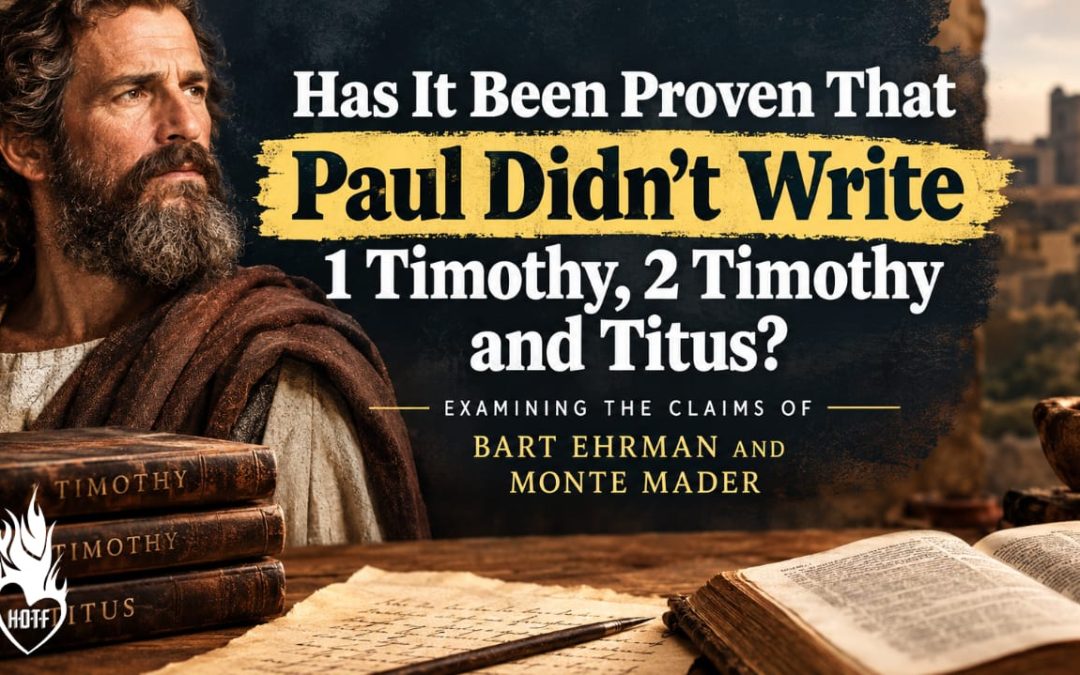
If you've spent any time watching YouTube debates or reading skeptical scholarship, you've probably heard the claim:
"Paul didn't actually write 1 Timothy, 2 Timothy and Titus."
This argument has become increasingly popular through the work of New Testament scholar Dr. Bart Ehrman and has been repeated by numerous critics of Christianity, including YouTube commentators like Monte Mader.
The claim is often presented as though the matter has already been settled. The evidence, we're told, "proves" that Paul could not have written these letters.
But does it?
Or are we dealing with a genuine historical debate where reasonable scholars reach different conclusions?
Let's carefully examine the evidence.
Why This Debate Matters
The question is much bigger than who held the pen.
If Paul did not write these letters, then several important questions follow.
Why did the early church accept them as Scripture?
How did they become part of the New Testament?
Were the earliest Christians deceived by a forgery?
Or is there another explanation that better fits the historical evidence?
These are important questions, and they deserve careful, honest investigation.
What Ehrman and Monte Mader Argue
The case against Pauline authorship usually rests on five main arguments.
Some of these arguments are stronger than others, but none should simply be dismissed.
Let's examine them one by one.
Claim 1: The Vocabulary Is Too Different
The Argument
Perhaps the strongest argument concerns language.
Scholars have observed that the Pastoral Epistles contain many Greek words that never appear in Paul's undisputed letters, such as Romans, Galatians and 1 Corinthians.
In addition, familiar words are sometimes used differently.
For example, Paul often uses "faith" to describe trusting in Christ.
In the Pastoral Epistles, "the faith" frequently refers to the body of Christian teaching that must be preserved and defended.
Critics argue that this sounds like a later stage of Christianity rather than Paul's lifetime.
The Response
The vocabulary differences are real.
The question is whether they prove a different author.
Different subjects naturally require different language.
Compare a doctor writing a medical journal article with the same doctor writing a letter to a close friend.
Would we expect identical vocabulary?
Certainly not.
Paul's earlier letters deal with subjects such as justification by faith, unity between Jews and Gentiles and correcting problems within churches.
The Pastoral Epistles focus on appointing elders, caring for widows, dealing with false teachers and mentoring a young church leader.
Those topics naturally require different vocabulary.
It is also worth remembering that Paul likely used secretaries, known as amanuenses, when writing some of his letters. Different assistants could easily have influenced style while preserving Paul's ideas.
The vocabulary argument raises important questions, but it does not prove that Paul was not the author.
Claim 2: The Church Structure Is Too Advanced
The Argument
The Pastoral Epistles contain detailed instructions regarding overseers, elders and deacons.
Critics argue that this reflects a second-century church with an organized hierarchy that did not yet exist during Paul's ministry.
The Response
This argument faces an immediate difficulty.
Church leadership already existed while Paul was alive.
Acts 14:23 records Paul appointing elders in every church.
Philippians 1:1 specifically greets "the overseers and deacons."
Acts 20 records Paul meeting with the Ephesian elders and instructing them concerning their responsibilities.
The existence of organized leadership therefore cannot be used by itself to date the letters after Paul's death.
What the Pastoral Epistles provide is not the invention of church leadership but practical instruction for leaders who already existed.
That is exactly what we would expect if Paul were mentoring Timothy.
Claim 3: The Theology Is Different
The Argument
Critics often argue that Paul's earlier letters emphasize grace and salvation through faith, whereas the Pastoral Epistles focus on preserving sound doctrine, church order and good works.
They conclude that these letters reflect a later generation concerned with protecting established Christian tradition.
The Response
This comparison can be misleading.
Different situations require different emphasis.
Galatians was written to confront legalism.
Romans explains the gospel in detail.
Philemon addresses reconciliation between believers.
First and Second Timothy were written to a pastor responsible for leading churches.
A letter about church leadership should not be expected to sound identical to a letter defending justification by faith.
Different emphasis is not the same as different theology.
The Pastoral Epistles continue to teach salvation by God's grace while addressing practical ministry concerns.
Claim 4: The Timeline Does Not Fit Acts
The Argument
The journeys described in the Pastoral Epistles do not fit neatly into the timeline recorded in the Book of Acts.
Critics conclude that someone writing after Paul's death invented these travels.
The Response
This conclusion depends upon an assumption.
Acts ends with Paul under house arrest in Rome.
It never says Paul died there.
It never claims to record the remainder of his life.
Many early Christian writers believed Paul was released from imprisonment, continued traveling for several years and was later arrested again before his execution under Nero.
If that reconstruction is correct, the events described in the Pastoral Epistles fit naturally into that later period of ministry.
Acts is an unfinished biography, not an exhaustive account of Paul's life.
Claim 5: The Letters Were Forged
The Argument
Bart Ehrman argues that an unknown Christian wrote these letters after Paul's death while pretending to be Paul.
According to this view, the Pastorals are examples of pseudonymous writing.
The Response
This raises an equally important historical question.
If these letters were forged, why did the earliest Christians accept them so quickly?
The churches closest to Paul's lifetime would have been in the best position to recognize authentic apostolic teaching.
Early Christian writers such as Polycarp appear to know these letters. By the late second century, Irenaeus and Tertullian explicitly quote them as Paul's.
Critics must explain not only why someone would write in Paul's name, but also how those writings gained widespread acceptance without leaving clear evidence of significant controversy.
The early reception of the Pastorals remains one of the strongest arguments in favor of Pauline authorship.
What About the Personal Details?
Second Timothy contains remarkably personal references.
Paul asks Timothy to bring his cloak.
He asks for his books and parchments.
He names friends who remained faithful and others who abandoned him.
Critics argue these details were invented to make the letter appear authentic.
That is possible.
But it is equally possible that they are authentic because they describe real events.
These details do not prove either position, but they certainly make the letters feel like genuine personal correspondence rather than abstract theological works.
What Critics Often Overlook
There are several facts that rarely receive attention in popular discussions.
First, ancient authors often wrote differently depending on their audience.
Second, secretaries commonly assisted in writing letters, which could influence style.
Third, Acts never claims to describe every event in Paul's ministry.
Fourth, the earliest Christians overwhelmingly accepted these letters as Pauline.
Finally, there is no ancient manuscript identifying another author, no confession from a later writer claiming responsibility and no historical record of the early church exposing the Pastorals as forgeries.
These facts do not prove Paul wrote them.
However, they do show that the historical picture is more complex than many popular presentations suggest.
Is Modern Scholarship Unanimous?
No.
This is one of the biggest misconceptions surrounding the debate.
Many modern scholars agree with Bart Ehrman that the Pastoral Epistles were written by someone other than Paul.
However, many respected New Testament scholars continue to defend Pauline authorship or argue that the evidence against it is far from decisive.
Scholars such as Luke Timothy Johnson, Ben Witherington III, Craig Keener, George Guthrie, Philip Towner, Stanley Porter, Michael Kruger and Craig Blomberg have all offered significant responses to the arguments against Pauline authorship.
This does not mean every one of them agrees on every detail.
It simply demonstrates that the debate remains active within serious scholarship.
The claim that "scholars have proven Paul didn't write Timothy" is therefore inaccurate.
A more honest statement would be that many scholars disagree about the evidence.
So Has It Been Proven?
No.
Bart Ehrman and others raise thoughtful and important questions.
The vocabulary differences are genuine.
The historical questions deserve careful consideration.
The church structure reflects mature leadership.
None of these observations should be ignored.
But none of them amount to proof.
The earliest historical testimony consistently attributes these letters to Paul.
Alternative explanations exist for the linguistic differences.
The timeline after Acts remains historically possible.
The widespread acceptance of the Pastorals by the earliest Christians must also be explained.
At the end of the day, this is not a settled fact.
It is a historical debate.
As followers of Christ, we should never fear honest investigation. Christianity has always invited people to examine the evidence because truth has nothing to fear from careful inquiry.
Rather than repeating slogans from either skeptics or defenders, we should weigh all the evidence with humility, intellectual honesty and a genuine desire to follow the truth wherever it leads.
The question is not whether objections to Pauline authorship exist.
They certainly do.
The real question is whether those objections are strong enough to overturn the testimony of the earliest Christians and the historic understanding of the Church.
That is a far more difficult case to make than many popular presentations suggest.