
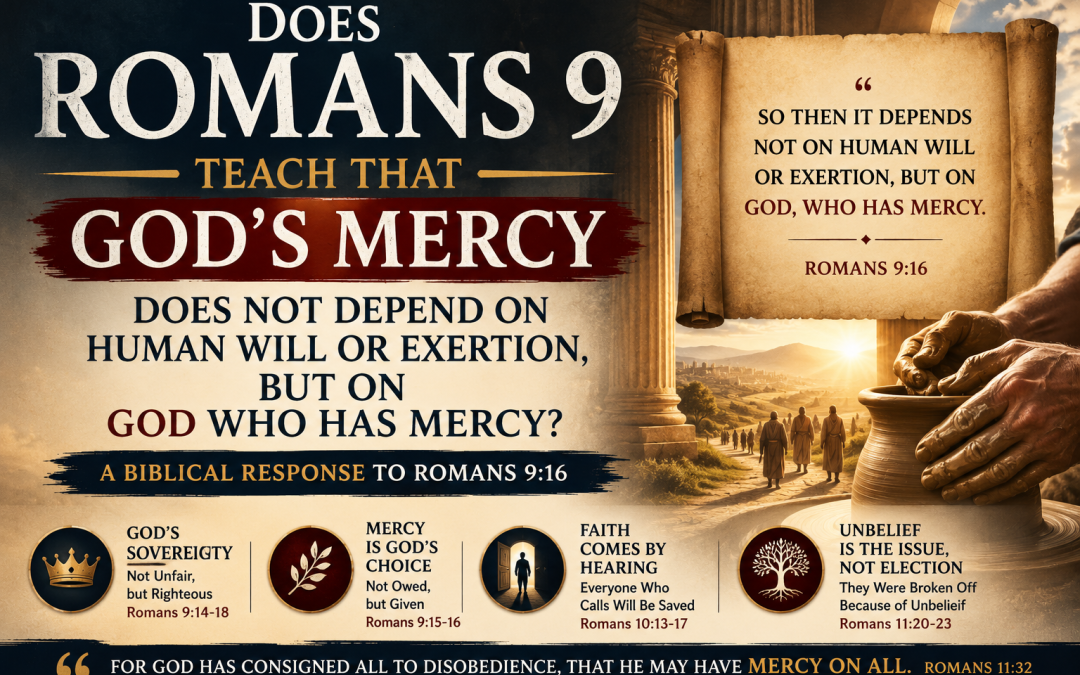
One of the most common Calvinist arguments comes from Romans 9, especially verse 16:
"So then it depends not on human will or exertion, but on God, who has mercy."
At first glance, this can sound like Paul is teaching that salvation has nothing to do with human response and everything to do with God selecting certain individuals for salvation.
But is that what Romans 9 is actually about?
To answer that question, we must first understand why Paul wrote Romans 9.
The Context of Romans 9
Romans 9 begins with Paul's grief over Israel:
"I have great sorrow and unceasing anguish in my heart." (Romans 9:2)
Why is Paul grieving?
Because many Israelites have rejected their Messiah.
The issue being addressed is not, "Why are some individuals elected to heaven while others are elected to hell?"
The issue is, "Has God's promise to Israel failed?"
Paul answers:
"It is not as though the word of God has failed." (Romans 9:6)
The entire discussion centers on God's covenant purposes and His right to determine how His redemptive plan unfolds.
Jacob and Esau
Calvinists often point to God's statement:
"Jacob I loved, but Esau I hated."
However, Paul is quoting Malachi, written long after Jacob and Esau had died.
The context of Malachi is not two unborn individuals going to heaven or hell.
It is the nations that descended from them: Israel and Edom.
God chose Jacob's line to carry forward the covenant promises through which the Messiah would come.
The passage is about covenant purpose, not eternal destiny.
Pharaoh
Romans 9 also speaks about Pharaoh:
"For this very purpose I have raised you up."
Notice that Paul does not say Pharaoh was created for eternal damnation.
Pharaoh's role in the Exodus demonstrated God's power and glory.
Furthermore, Exodus repeatedly says that Pharaoh hardened his own heart before Scripture speaks of God hardening it.
God's hardening was judicial. God gave Pharaoh over to the stubbornness he had already embraced.
This is consistent with Romans 1, where God gives people over to the consequences of their choices.
The Potter and the Clay
Perhaps the most famous image in Romans 9 is the potter and the clay.
Calvinists often use this passage to argue that God creates some people for salvation and others for destruction.
But Paul did not invent this illustration.
He borrowed it from the Old Testament, particularly Jeremiah 18.
In Jeremiah, the clay is not helplessly predetermined.
The nation can respond and change.
God explicitly says that if a nation repents, He will relent of judgment, and if a nation turns to evil, He will withdraw blessing.
The potter-clay imagery demonstrates God's authority over nations and peoples, not a fatalistic decree that individuals cannot respond to Him.
What About Romans 9:16?
Romans 9:16 says:
"So then it depends not on human will or exertion, but on God, who has mercy."
What is the "it"?
The Calvinist assumption is that "it" refers to individual salvation.
But in the immediate context, Paul is discussing God's choice of Isaac over Ishmael, Jacob over Esau, and His dealings with Pharaoh.
The point is that God's covenant purposes are not determined by human effort, ancestry, or privilege.
God decides how His redemptive plan unfolds.
No one can earn a place in that plan through lineage, works, or personal merit.
The verse is not denying that people must respond to God in faith.
Rather, it is denying that anyone can claim God's mercy as something owed to them.
Romans 10 Changes Everything
One of the greatest challenges to the Calvinist reading is that Paul continues into Romans 10.
There he says:
"Everyone who calls on the name of the Lord will be saved." (Romans 10:13)
He also says:
"Faith comes from hearing, and hearing through the word of Christ." (Romans 10:17)
The emphasis is on hearing, believing, and responding.
Paul never concludes that people are lost because they were not elected.
Instead, he repeatedly points to unbelief as the reason for Israel's condition.
Romans 11 Completes the Argument
The discussion reaches its climax in Romans 11.
Paul says concerning unbelieving Jews:
"They were broken off because of their unbelief." (Romans 11:20)
Notice what he does not say.
He does not say they were broken off because they were never elected.
He says they were broken off because of unbelief.
Even more striking, Paul says:
"And even they, if they do not continue in their unbelief, will be grafted in." (Romans 11:23)
The issue is faith versus unbelief.
The door remains open.
The Real Point of Romans 9
Romans 9 is not teaching that God arbitrarily chooses some individuals for salvation and others for condemnation.
It is teaching that God is sovereign in carrying out His redemptive plan.
God was free to choose Isaac rather than Ishmael.
God was free to choose Jacob rather than Esau.
God was free to use Pharaoh in the Exodus.
God was free to include Gentiles in His covenant people.
And God is free to show mercy to all who come through faith in Christ.
The surprise of Romans 9 is not that God excludes people.
The surprise is that God has opened the door wider than many expected.
The story that begins with Israel ultimately expands to include the nations.
That is not a limitation of mercy.
It is an expansion of mercy.